The Crisis of Competence
Why Mental Health Needs a "Flight Simulator" Moment
Vrishank Saini
Co-Founder
By the SimCare AI Research Team
In 1994, the general aviation accident rate was 9.08 per 100,000 flight hours. By 2016, that number plummeted to 0.91. Commercial aviation fatalities are now so rare they are statistical anomalies.
Did pilots suddenly evolve? No. The industry embraced High-Fidelity Simulation. They stopped practicing engine failures on passengers and started practicing them in a box, where failure was free but the learning was mandatory.
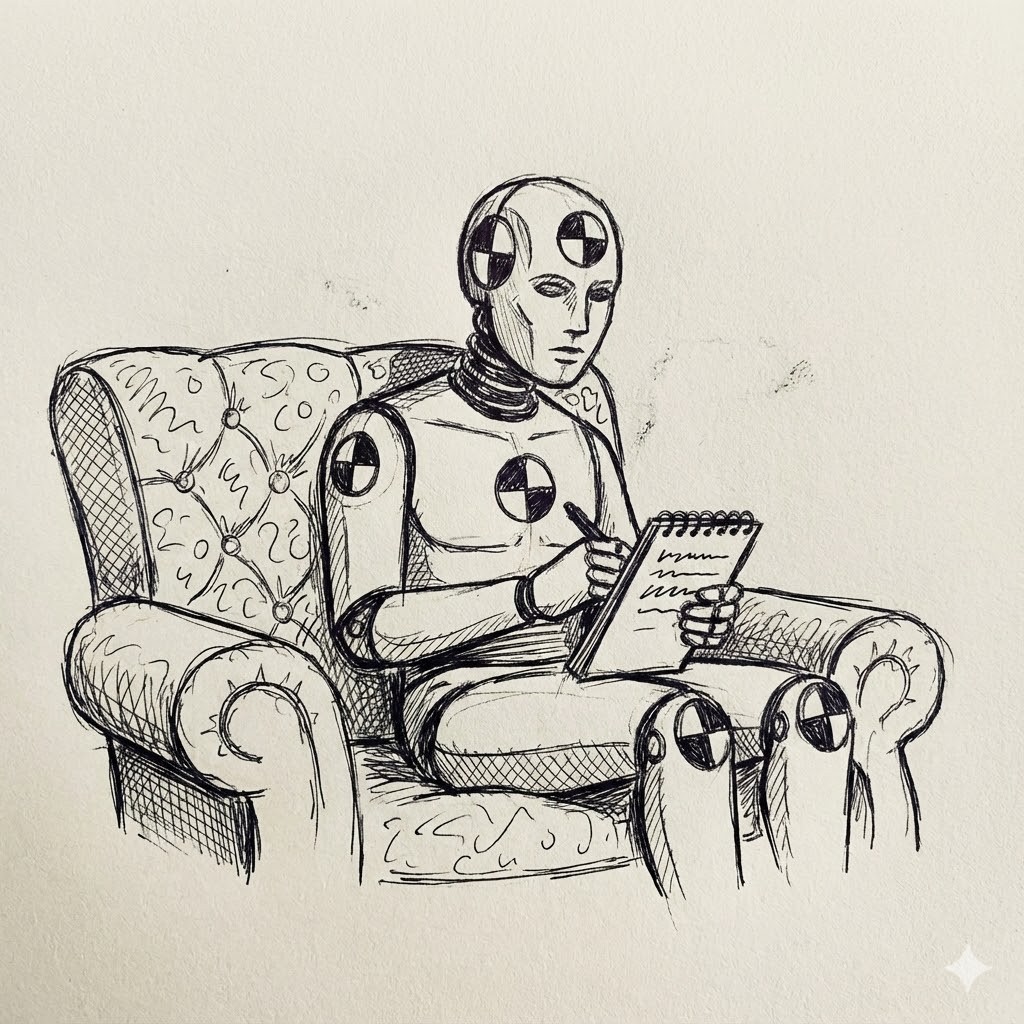
The mental health profession is currently flying without a simulator. And the data shows we are crashing.
While demand for therapy surges, the core metric of our profession—clinical effectiveness—remains stagnant. For decades, we have operated on the "Time-in-Seat" fallacy: the assumption that a therapist with 20 years of experience is inherently safer and more effective than one with two4.
The data says otherwise.
At SimCare AI, we are done with the polite fiction that "experience equals expertise." We are building the flight simulator for the mind because the "master-apprentice" model is structurally obsolete. Here is the evidence.
The "Lake Wobegon" Delusion: You Aren't as Good as You Think
The most formidable barrier to clinical excellence is the therapist’s own ego. It’s what researchers call the "Lake Wobegon Effect"—a statistical impossibility where everyone believes they are superior.
In a seminal study analyzing self-assessment bias, mental health providers were asked to rank their skills against their peers. The results were damning:
25% of professionals rated themselves in the 90th percentile.
100% rated themselves as "above average".
0%—not a single clinician—viewed themselves as below average.
If 100% of your workforce thinks they are already experts, nobody learns. This delusion creates a "blind spot" for deterioration. Therapists estimate that only 1.64% of their clients get worse, while objective data shows the real rate is 5% to 10%.
Traditional training feeds this delusion. In peer role-play, your "client" is a classmate who wants you to pass. They withhold negative feedback to avoid awkwardness, a phenomenon known as the MUM Effect. You leave the classroom thinking you’re a genius because you "cured" your friend.
SimCare AI breaks this cycle. Our AI avatars don’t care about your feelings. They care about your competence. If you miss a suicide risk marker, the system flags it immediately. It is the cold, hard mirror the industry has been avoiding.
The "Drift": Why Experience Does Not Equal Competence
In surgery, outcomes improve with volume. A veteran surgeon has a 61% lower error rate than a novice because the feedback loop is immediate: you cut the wrong vessel, there is blood.
In psychotherapy, the feedback loop is severed. You might say the wrong thing, and the client simply doesn't return. You tell yourself it was "resistance."
Consequently, therapists suffer from "Therapeutic Drift." Longitudinal studies of 170 therapists over 18 years revealed that, on average, effectiveness actually declines slightly as experience increases (approx 0.012 standard deviations per year).
We drift because we rely on automaticity. We stop planning. We stop trying new interventions. We coast.
To stop the drift, you need Deliberate Practice (DP). This requires:
Repetition: Doing the same micro-skill 50 times.
Immediate Feedback: Knowing instantly if you hit the mark.
Successive Refinement: Trying again until it's perfect.
You cannot ask a real client to "stop crying and let me try that reflection again." You can ask SimCare AI. Our platform allows for infinite repetition of high-stakes scenarios—suicide assessment, de-escalation, trauma disclosure—until the neural pathways for safety are cemented.
The Reliability Crisis: Human Supervision is Flawed
"But I have a supervisor. They check my work."
Do they? Research shows that a supervisor's rating of a trainee has statistically insignificant correlation with actual client outcomes.
Human supervision is plagued by low Inter-Rater Reliability (IRR). A single faculty member rating a student has a reliability prediction of only 0.4016. That is barely better than a random guess. To get a reliable score, you would need a panel of 6 independent raters, which is economically impossible.
Furthermore, humans are biased. Junior supervisors give higher scores than senior ones (Seniority Bias), and we succumb to the "Halo Effect," where a charming trainee masks clinical incompetence.
AI provides the only scalable objectivity.
Recent data confirms that AI scoring systems for clinical interactions can achieve reliability coefficients between 0.86 and 1.00, matching or exceeding human consensus.
SimCare AI provides a standardized patient that never fatigues, never drifts, and scores you based on data, not how much they like you.
The Verdict: Stop Guessing, Start Measuring
The aviation industry achieved zero fatalities by refusing to accept "good enough." They demanded proof of competence in a simulator before a pilot ever touched a passenger jet.
Mental health care is a high-reliability profession operating with low-reliability training tools. The "Apprenticeship Model" is a black box that hides incompetence behind closed doors.
SimCare AI is not just a tool; it is a paradigm shift. We offer:
Safety: A "sandbox" where catastrophic failure results in learning, not harm.
Objectivity: Feedback based on granular metrics (tone, sentiment, protocol adherence), immune to social bias.
Mastery: The ability to practice a skill until the error is eliminated.
We are moving the field from the "Art of Therapy" to the "Science of Clinical Performance."
Are you ready to see how good you actually are?
Read more articles here
Fresh takes, expert insights, and ideas worth reading—all in one place.